
From mobility and construction to medical, defense, aerospace, and clean energy, industries around the world rely on Physical Vapor Deposition (PVD) and Plasma-Enhanced Chemical Vapor Deposition (PECVD) technologies for high-performance surface treatments.
These eco-friendly coating methods use vacuum environments to deposit ultra-thin films—ranging from just a few nanometers up to several tens of microns. With hardness values between 1000 and 5000 Hv, these coatings enhance durability, wear resistance, and surface functionality without compromising environmental standards.
Whether you’re optimizing components for extreme environments or improving product lifespan, PVD and PECVD coatings offer sustainable, high-precision solutions across a wide range of applications.
PVD Coatings:
Durable, Versatile, and Visually Appealing
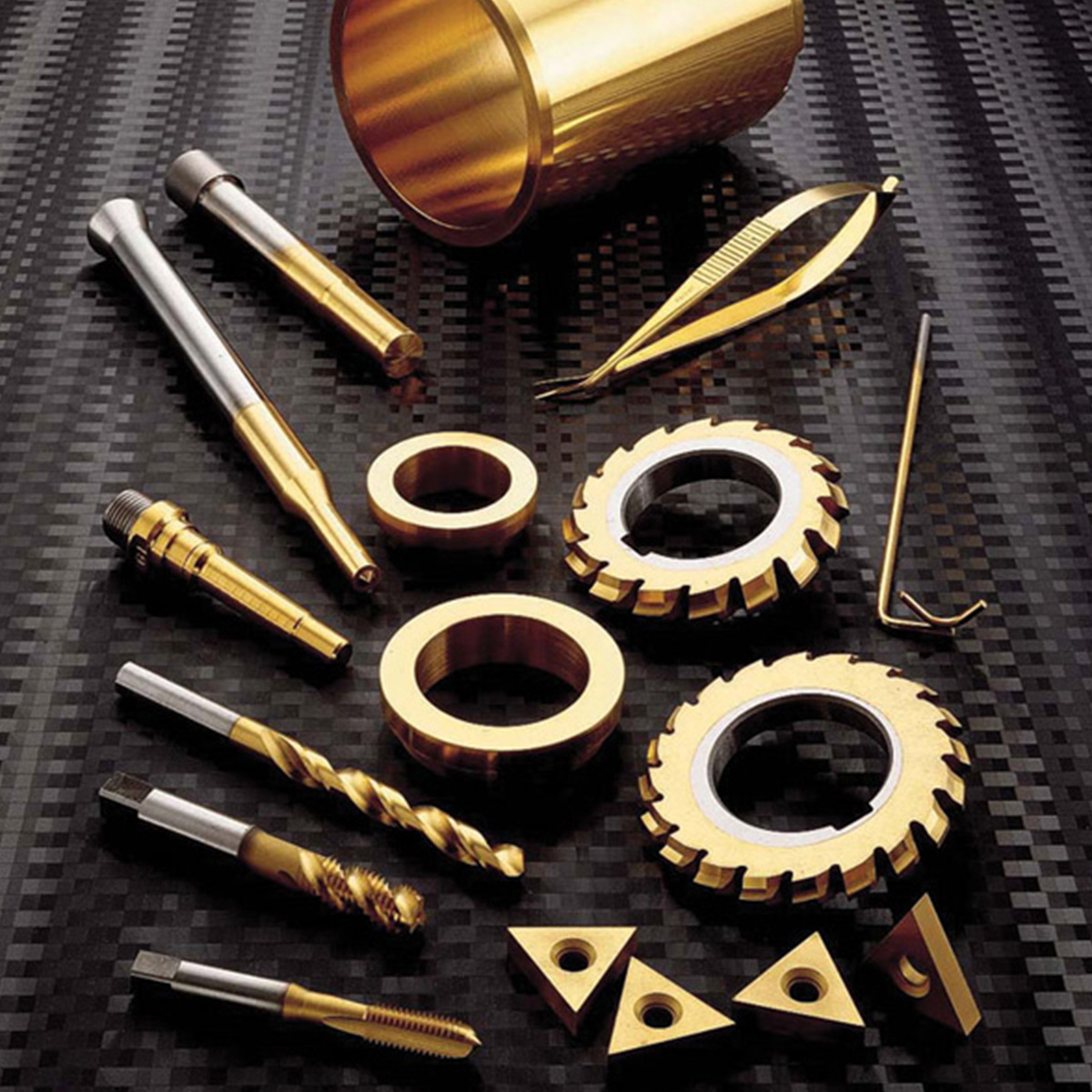
PVD coatings are known for their extreme hardness, low friction, heat resistance, and long-lasting durability. Used across industrial, cosmetic, and decorative applications, PVD delivers both performance and aesthetic appeal—available in a wide range of colors.
HEF NA’s proprietary PVD technology supports high deposition rates, precise thickness control, and exceptional adhesion—even at low temperatures. Coatings can be applied to steels, ferrous and non-ferrous metals, plastics, glass, and elastomers. Common applications include:
- Industrial: Cutting tools, forming tools, precision automotive parts, medical devices
- Decorative: Firearms, door hardware, kitchen appliances, shaving blades
- Optical and High-Tech: Scratch-resistant plastics, architectural glass, semiconductors, and optoelectronic components
PECVD Coatings:
Precision Coatings at Lower Temperatures
PECVD is a plasma-enhanced chemical vapor deposition process that allows for the creation of ultra-thin, conformal coatings at lower temperatures than traditional CVD methods. This makes PECVD ideal for temperature-sensitive materials and substrates.
Using vaporized gases that chemically react in a plasma field, PECVD forms thin films with enhanced uniformity, coverage, and surface properties. Industries such as electronics, optics, energy, and tribology rely on PECVD for coatings that require:
- Lower thermal budgets
- Improved barrier and electrical properties
- Excellent adhesion and film uniformity
Whether you’re enhancing performance-critical components or applying functional coatings to delicate substrates, HEF NA’s PVD and PECVD solutions offer the precision, efficiency, and versatility needed to meet today’s advanced engineering challenges.

Process Overview
PVD & PECVD coating involves the deposition of thin films (2-10 microns; 0.0001″-0.0004″) on the surface of components. Whereas liquid nitriding is a surface modification technology, the PVD coating process is conducted under high vacuum conditions and can be divided into three stages:
- Evaporation – Removal of material from the target, source, or cathode.
- Transportation – Travel of evaporated material from the source to the component being coated.
- Condensation – Nucleation and growth of the coating on the component surface.
Material is typically extracted from a high-purity solid source, such as titanium or chromium, using methods like sputtering or arc discharge. The material is transported through a plasma medium—a collection of charged particles influenced by magnetic fields—traveling in a “line of sight” from source to substrate. Plasma characteristics vary based on generation methods.
A PVD coating forms when plasma particles combine with reactive gases, like nitrogen, to create thin, hard layers such as titanium or chromium nitride. The coating’s properties depend on its chemical composition, sub-layer structure, ion energy, metal ion ionization, and atom mobility on the surface.
If a hydrocarbon gas is used as the source, it produces an ultra-hard, low-friction Diamond-Like Carbon (DLC) coating. This gas-based process is known as Plasma Enhanced Chemical Vapor Deposition (PECVD).
Various PVD technologies exist, including arc deposition and magnetron sputtering, which can be enhanced for higher deposition rates, strong adhesion, and diverse microstructures. HEF NA utilizes three advanced PVD methods:
- PEMS™ (Plasma Enhanced Magnetron Sputtering) is HEF NA’s patented triode system that enhances conventional magnetron sputtering using a secondary plasma source. It allows precise control of material flux, ion energy, and substrate bias—enabling the production of extremely dense, hard, or extra-hard layers with a low coefficient of friction. PEMS™ coatings offer high hardness, density, and toughness and can be finely tuned to meet specific tribological and application requirements.
- CAM™ (Coating Assisted by Microwaves) is an advanced vacuum technology that enables the deposition of hard, ultra-low-friction coatings at extremely low temperatures and pressures. This process significantly enhances efficiency and productivity by reducing thermal stress while maintaining exceptional coating performance.
- Cathodic Arc (M-ARC) is a high-throughput PVD-arc process that builds on conventional arc evaporation technology to deliver carbon-free coatings with significantly reduced droplet formation. This advancement enhances coating quality and makes M-ARC a cost-effective solution for applications requiring clean, durable PVD coatings.
Advantages of PVD & PECVD Coatings
HEF NA’s PVD and PECVD coatings deliver super-hard, low-friction, high load-bearing performance for industrial, automotive, and medical components. Reliable, eco-friendly, and versatile, they enhance efficiency, reduce wear, and solve friction-related challenges. Specific advantages include:
- Reduced friction and wear
- Increased service life for mechanical parts
- Protection of aluminum alloys against corrosion
- Protection against erosion
- Functionalizing surfaces: optical applications, decorative applications, electromagnetic shielding on polymers
Our PVD & PECVD Coatings:
Commercial Name | Thickness | Maximum Use Temp | |
|---|---|---|---|
CERTESS NITRO T | <5 microns | 800°C (1472°F) | More |
CERTESS NITRO TC | <5 microns | 500°C (932°F) | More |
CERTESS NITRO SD | <5 microns | 800°C (1472°F) | More |
CERTESS NITRO X | <5 microns | 500°C (932°F) | More |
CERTESS NITRO Ti | <5 microns | 500°C (932°F) | More |
Calico D | <5 microns | 1100°C (2012°F) | More |
Calico D-2 | <5 microns | 1100°C (2012°F) | More |
Titanium Carbo-Nitride | <4 microns | 400°C (752°F) | More |
Titanium Nitride | <7 microns | 600°C (1112°F) | More |
Titanium Aluminum Nitride | <4 microns | 750°C (1382°F) | More |
Aluminum Titanium Nitride | <4 microns | 900°C (1652°F) | More |
Chromium Nitride | <4 microns | 700°C (1292°F) | More |

HEF NA offers several other application-specific PVD & PECVD Coatings.
For additional details, please contact us.
Contact Us